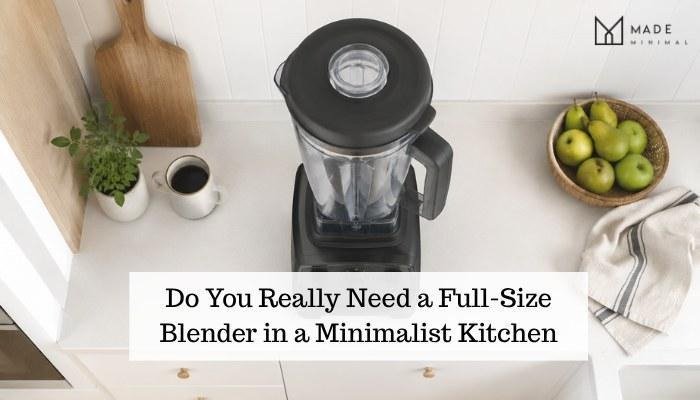
No, you don’t always need a full-sized blender. A mini blender handles most of what a standard model does, with a fraction of the bench space. In a minimalist kitchen, bench space is finite, and a traditional blender claims more of it than almost any other appliance.
The full-size version is an easy purchase to justify at the time. It’s what most of us have always done. So the coffee machine, the fruit bowl, the cutting board all compete for whatever counter space is left. And slowly, your kitchen island starts to feel like a storage unit.
At Made Minimal, we’ve seen this kitchen clutter pattern recur across countless minimalist home setups. This article covers the real bench space cost, the daily tasks a mini blender handles, and the practical swap most minimalist kitchens need.
Time to sort it out.
The Full-Size Blender Myth
Few of us ever stop to question “does full-size really mean more useful?” That assumption leaves pantries full of gadgets nobody uses and benches packed with appliances that haven’t moved in months.
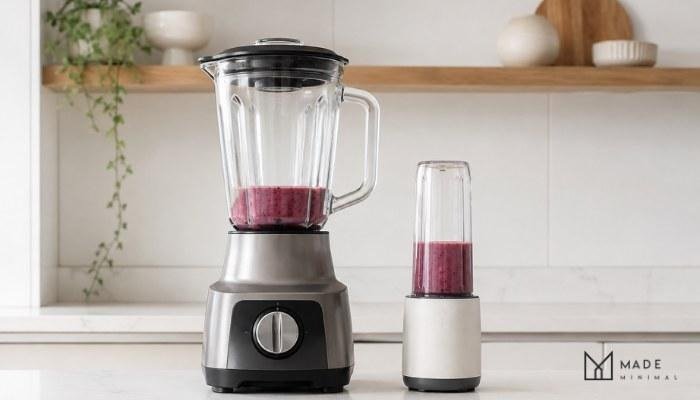
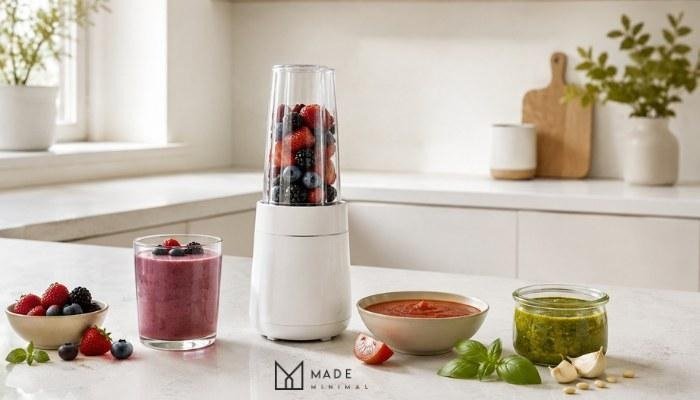
The full-size blender is a prime example. The average home cook uses this gadget for smoothies, sauces, and the odd soup. And a smaller blender handles all three while claiming a fraction of the workspace (and yes, we’ve all bought the full-size version “just in case”).
Think of it this way: a full-size blender on your counter is like a parked truck in a one-car garage. It stays there, blocks everything else, and your cooking space shrinks every single day.
See also: 11 Things That Actually Separate Infrared from Traditional Saunas (Retailers Included)
What a Smaller Blender Can Do in a Minimalist Kitchen
Whatever you use your blender for daily, a smaller option handles it just as well. It also fits in a fraction of the countertop space (most models are dishwasher-safe, so cleanup takes seconds).
Based on what we’ve seen across dozens of minimalist kitchen setups, clearing the blender off the counter has the most visible impact. This comparison puts it in perspective:
| Mini Blender | Full-Size Blender | |
| Bench Space | Under 20cm footprint | 30–40cm footprint |
| Daily Tasks | Smoothies, soups, dips, sauces | Same daily tasks, larger capacity |
| Price | More affordable, less storage needed | Higher price, needs more cabinet space |
And once your bench is clear, the rest of your kitchen starts to feel like yours again.
If you’ve ever cooked in a cluttered kitchen, you know what we mean. Less hunting for the right pan and no more shifting things around just to find the sink.
The Counter Space Cost of a Full-Size Blender
The coffee machine gets pushed back, the cutting board loses its spot, and the fruit bowl lands on the table, all from one appliance (a standard full-size blender footprint is roughly the size of an A4 sheet of paper).
What’s more, research in the Personality and Social Psychology Bulletin found that cluttered home environments raise stress hormone levels and hurt your health over time.
Here’s what a full-size blender pushes off your bench:
- Your Favourite Coffee Machine: A full-size blender pushes your coffee machine to the back of the shelves. For most people, that’s enough to throw off their entire morning routine.
- Pots and Pans Follow Next: Pots, pans, and utensils move onto shelves instead of sitting within reach. In practice, digging through cabinets for basic cookware slows down every meal you cook.
- No Bench Space Left: Once your cabinets crowd out with displaced items, everything without a home lands on your kitchen island. Your kitchen loses its sense of order, and it shows every time you cook.
If you remember the footprint comparison, a compact blender handles the same daily tasks in under 20cm of workspace. For a minimalist kitchen, that’s a significant difference.
When a Full-Size Blender Is Worth the Space
To be fair, a full-size blender does have its place. Batch cooking meals for the week, making large soups for the family, or preparing food in bulk calls for one. At that point, a full-size blender earns every centimetre of bench space it needs.
The distinction comes down to capacity. A smaller blender suits daily cooking tasks well, but large batch meals are a different story. For high-volume cooking, capacity and motor power genuinely count, and a full-size blender handles that load far better. In those cases, a full-size blender is the right size for your kitchen.
The rest of the time, though, it’s 30–40cm of bench space used once or twice a week at best.
Making the Switch to Small Kitchen Appliances
We’ve helped a lot of people clear out their kitchens with efficient appliances, and the full-size blender is always the first thing they stop missing. Within a week, that freed counter space becomes the new normal.
The most reliable way to know if an appliance deserves 30–40cm of prime counter space is to remove it for two weeks. Your full-size blender goes in the cabinet, and you count how many times you reach for it. If it stays untouched, send it to the donation box.
Good adaptable home design works on that same principle. Keep the appliances you reach for every day (like your kettle, toaster, and coffee mugs), and your bench gives you enough room to cook on.
Thirty Centimetres Back with One Simple Swap
Bench space in a minimalist kitchen is too valuable to hand over to an appliance you rarely use. A full-size blender is usually the culprit, and removing it from your counter gives your kitchen back its breathing room. A mini blender solves that without any compromise on daily cooking tasks.
For a clearer idea, this article walked through the bench space cost, the daily capabilities of a smaller blender, and when a full-size blender is still the right call. From here, the two-week cabinet test does the rest of the work for you.
At Made Minimal, we stock small kitchen appliances built for pared-back spaces and real daily use. Our team is ready to help you find the right fit, so your kitchen works the way it should.
